Kaimai buster
The 'Kaimai Buster' explained
You might have heard the term ‘Kaimai Buster’, which is a rare, extreme wind event owing to the very unique geography around the Kaimai Range.
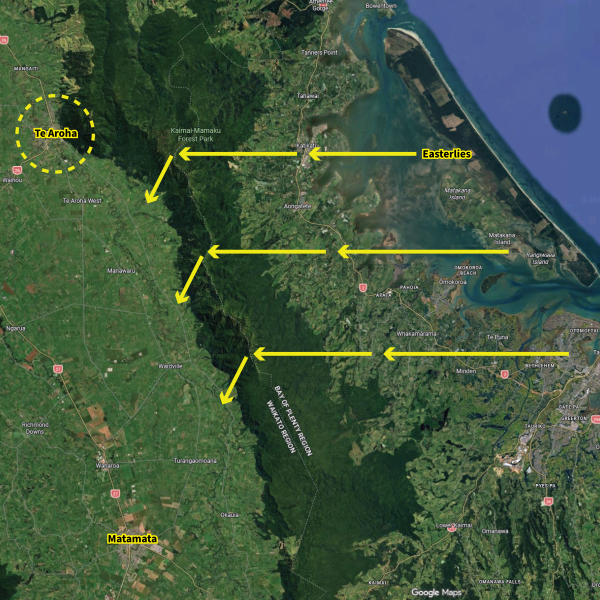
If you’ve driven SH29, you will have noticed that the Waikato side is very steep, while the Bay of Plenty side descends gradually from the summit to the sea. What’s less obvious from the road is that the Kaimais also run near perfectly north to south, creating a massive wall squarely against easterly winds from the Pacific Ocean. This means easterlies travel up the range with relatively stable force until they reach a sudden drop on the western side and gravity pulls the air down rapidly towards Te Aroha, Matamata, SH27 and the rest of the Waikato (see map).
Meteorologists call this the ‘Ski Jump Effect’. Generally, this alone won’t create a Kaimai Buster, but under certain conditions other effects can exacerbate the ski jump creating a violent localised wind event on the western side:
Topographic gaps
Because the Kaimais feature deep valleys and saddles (like Karangahake Gorge and the Kaimai Summit road), easterly winds don’t just travel over the range. Some are forced through the gaps, which increases their velocity going from a wide to a narrow space. The gaps act like funnels creating isolated mini-busters. These strong wind phenomena have the potential to blow vehicles around or potentially knock them over.
‘A Lee Wave’ is the primary engine behind a buster scenario. This occurs when heavy air flies up the Kaimais and then overshoots at the top and crashes down on the other side, aka the “the lee side” of the Kaimais. The air accelerates as it descends on the lee side, and with a stable atmospheric environment this can allow the winds to hit with massive force. The air will continue to fluctuate up and down as it passes over, creating a ripple like effect which may be felt for kilometres. Te Aroha lies precisely in the impact zone of this wave, so locals will likely have experienced one before.
Kaimai Busters are possible whenever there are strong easterly or northeasterly winds in the area. Keep up to date with weather for this weekend at MetService New Zealand. If strong winds are imminent, tie down your trampoline and other heavy outdoor objects. Remove anything that could become airborne and damaging. Right now, you can make a list of items to bring inside or tie down when strong winds are forecast to help you remember when the time comes.