
Biodiversity describes the variety of life in an area, including plants, animals, ecosystems and the connections between them. In New Zealand, the term is often used in relation to native plants and animals and the habitats that support them.
This page explores the current state of biodiversity in the Waikato, how it has changed over time, and why protecting native species and habitats matters.
What is biodiversity and why does it matter?
Biodiversity is the variety of life that surrounds us, from plants and animals to the ecosystems they live in and the connections that bind them together. It includes everything from forests and oceans to all the different species within these environments and the relationships between them.
When ecosystems are healthy and diverse, they’re more resilient to change and better able to support life. These ecosystem services benefit everyone in the Waikato region, helping us adapt to climate challenges and sustain our way of life.
In te ao Māori, biodiversity is deeply rooted in whakapapa, the genealogy that links people, land, water and all living things. This worldview reminds us that the wellbeing of people and te taiao, or the natural world, are inseparable. So when we care for the environment, we care for ourselves and future generations.
The changing state of biodiversity in the Waikato region
Before 1840
Before European settlement, the Waikato region was covered in native vegetation (except for open water and areas of bare lava or permanent snow and ice).
Although the vegetation was native, not all of it was original. Almost half of the region, mainly the lowlands and the volcanic plateau, had been burnt off and was covered in scrub.
Higher, wetter, or less accessible areas remained in mature kauri, beech or podocarp forest (podocarps include rimu, totara and kahikatea). Native dune vegetation (pingao and spinifex) was found on the coast, especially at harbour mouths and river deltas. There were vast freshwater wetlands near the Lower Waikato River and Hauraki Plains.
The region supported unique plants and animals, with many plants, birds, reptiles, frogs, insects and snails.
Land mammals were rare - only three species of bat. The exact number of land species present in 1840 is unknown, although we do know that some species were already extinct by then, including species of moa and the giant eagle.
The current state
The Waikato region is still home to many native plants and animals. We have:
- more than 900 native plants
- 124 native bird species
- 19 reptiles (including geckos, skinks and tuatara)
- two species of native bats
- two native frogs.
- Our streams and rivers are also home to many types of fish and invertebrates.
Several native species are unique (endemic) to the Waikato region:
- Archey’s frog is only found in Whareorino Forest (south west of Te Kuiti) and in the Coromandel Range.
- Te Aroha and Moehau stag beetles
- Mercury Island tusked wētā
- Mahoenui giant wētā.
- and some unique snails and beetles associated with limestone habitat.
We also have unique plant species:
- Awaroa koromiko/hebe (Veronica scopulorum) on the limestone of the West Coast.
- Wetland bog plants - Swamp Helmet orchid (Corybas carsei) and the giant wire rush (Sporodanthus ferrugineus) and its associated moth 'Fred the thread' (Houdinia flexilissima)
- Many plant species found in our geothermal areas are common only in the Waikato. These include some ferns that are usually associated with tropical areas.
But around only 27 per cent of our region (approximately 676,863 ha) remains in native vegetation, and at least 300 species of our native plants and animals that live there are threatened with extinction. This includes all our bats and frogs and 40 per cent of the birds, and around 1 in every 5 native plant species in the region.
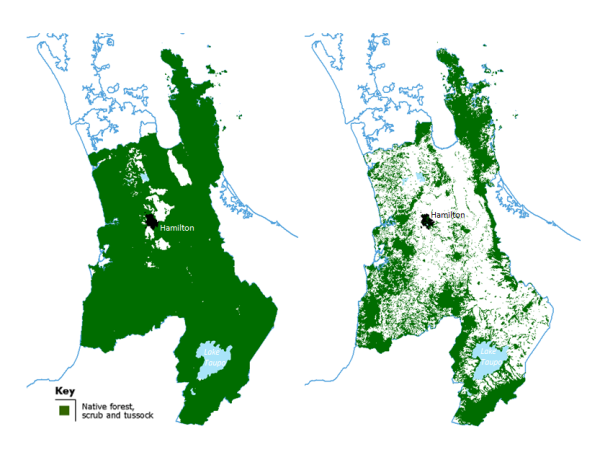
Map of the historic and current extent of native forest, scrub and tussock in the Waikato region
© Waikato Regional Council | View map disclaimer, licensing and data sources
Native forest covers 19 per cent of the region. Scrub, wetland, dune, geothermal, and tussock vegetation make up the remaining native vegetation. Most of today’s native vegetation occurs in the hill country. In the vast lowland area, only 18 per cent of pre–European vegetation is left.
Within our region, vegetation has not been cleared evenly. Some types of vegetation remain in similar proportions to their 1840 extent. For example, the extent of some high altitude vegetation types, such as beech forest, is largely unchanged.
But in other areas, little remains of the original vegetation, for example:
- Mature kauri forests were heavily logged.
- Extensive wetland areas have been drained for farming and only 25 percent of the original wetlands remain.
- Large areas of sand dune were converted from native spinifex and pingao communities to pine plantations. Introduced plants, such as marram grass, have invaded many of the dunes.
The rate of land clearance in the Waikato region has slowed. Now the greatest threat to our native species comes from introduced species such as possums, rats and stoats. These pests have become established in all of our mainland forests.
Footnotes
Map licensing and data sources
- Historic (around 1840): Regional Indigenous Vegetation Inventory (1840) - Leathwick, J. Clarkson, B. and Whaley, P. 1995: Vegetation of the Waikato Region: Current and Historic Perspectives. Landcare Research Contract Report LC9596/022. Landcare Research, Hamilton.
- Current: Land cover database - Terralink International Limited. COPYRIGHT RESERVED.