
Exotic caulerpa
Overview
There are two almost identical species of exotic caulerpa now known to be in New Zealand waters – Caulerpa brachypus and Caulerpa parvifolia. Together we refer to them as exotic caulerpa.
Exotic caulerpa was first found in New Zealand in July 2021 at Aotea Great Barrier Island, and it has since been confirmed in the Waikato region in the Coromandel Peninsula marine area, including Ahuahu Great Mercury Island, Repanga Cuvier Island and Northern Coromandel locations between Fantail Bay and Square Top Island.
Since its discovery, Biosecurity New Zealand has been working closely with mana whenua at affected places, local councils and communities to try to slow its spread and find or develop potential ways to manage it.
What does it look like
Caulerpa brachypus and Caulerpa parvifolia are closely related and appear identical.
- They have green fronds up to 10 centimetres long in the shape of oar blades that rise from long runners or roots known as stolons.
- They can be found growing from below the tideline to 46 metres deep and on both hard, rocky surfaces and in sandy or silty areas.
- When established, exotic caulerpa can cover large areas of the seafloor in dense mats.
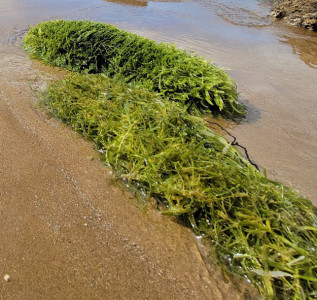
Caulerpa beachcast at Great Barrier Island Dec 2023 - Credit Sid Wales, MPI
Why are they a pest?
- Exotic caulerpa can spread rapidly, forming large underwater fields.
- It competes with other species for space and can upset the balance of local ecosystems, becoming the dominant or only species.
- Caulerpa spreads easily as fragments – it can easily catch on boat anchors, chains or other gear and equipment, and be unknowingly moved from location to location.
Report it
Report any suspected sightings of caulerpa outside the known areas to the MPI Pest and Diseases hotline on 0800 80 99 66. If possible, take photos and record the location.
Responsible for control
The Ministry for Primary Industries is the primary controlling authority for exotic caulerpa, with Biosecurity New Zealand leading the response and establishing legal controls.
There are anchoring and fishing rules for five controlled areas in New Zealand to stop the spread of exotic Caulerpa, including at Ahuahu Great Mercury Island.
Check the controlled area notices (CANs) and the rules that apply here.
How you can help
Make sure you comply with the area control notices for exotic caulerpa and always keep your boat and gear free of any seaweed before moving locations – exotic caulerpa can get snagged on anchors, chains and dive and fishing gear and be accidentally moved to new locations. Here are some simple actions you can take to avoid this:
When out at sea – before leaving a location, check your vessel’s anchor and anchor chain, and any equipment you’ve used in the water for any tangled seaweed. If you have an automatic retrieval system, still look out for any attached pieces of seaweed.
If you find any type of seaweed – remove it, bag or contain it securely so it can’t get back into the water, and take it ashore for disposal in a rubbish bin.
If you can’t securely contain it so it can’t get back into the water – put it back into the water from where it came.
If you find any seaweed when back at shore, remove it and put it in the rubbish.
More information
The New Zealand Ministry for Primary Industries (MPI), specifically its Biosecurity New Zealand division, is the primary source of information and management for exotic Caulerpa seaweeds in the country: Exotic Caulerpa seaweeds in New Zealand